

History
Set up for food production during World War One
Work to promote an allotment site started in 1916 when food production was a national priority during World War One. The first meeting was held in the Royal Oak Hotel, back Eldon Street on 16 Jan 1971, Mr Thomas Hall, superintendent of the Town Hall, presiding, and a committee was appointed. Permission to plough the field was granted and work started on 19 March. The land had been used to train soldiers and a layer of coal from that time can still be seen beneath the current ground level in various places. The land remains part of the Town Moor which the Freemen hold as primary tenants from the City. We lease the site from the Freemen and have always managed it independently from the Council.
Allotment plan 1917

The hut
The Hut was put up by members in their own time from February 1921 and officially opened by Mrs Davidson of Highbury on 27 June 1921, celebrated with a garden party for 80 members on 2 July.
Gas lighting and heating were installed so it could be used for social events.


Allotments for the unemployed
Helping to supply hospitals


Developments on the site

Sep 1933
Grass sown by the hut for a level space and the Show. Up until the 1950s we had our own annual show.
Feb 1934
All of plot 81 to be levelled with drainage for a quoit pitch and putting green
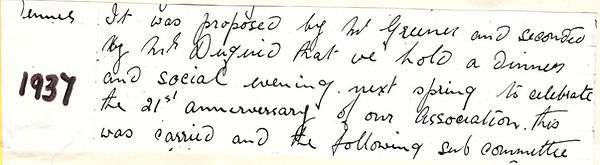
At war again - food shortages


Shortages continue after the war...


Mr Jack Mills was famous for his bees. His son Denis worked worked the family plot for many years. Beekeeping continues on the site for honey and pollination.


Changes to the allotment site
In 1917 the allotment site extended to the Great North Road. Probably the site was reduced to its present size when the city planned the "Coronation Walk" in 1937. The extra land was taken back for food production in 1939 and lost again with the "Floral Mile" in 1946. This plan shows the site with hut and lawn .

Women at the allotments
Women did not appear much in early records - very few held a plot. They were allowed to run whist drives in the hut. A Ladies' Section Show Committee emerged and before long more women held gardens - even full plots! Since then many have served on the committee with distinction.


Further changes at the site
In the 1980s we gained permission to put up greenhouses. Around the same time a garage was installed for storage and still serves as an equipment store. In 2000 we put in new water pipes. In the last twenty years, all the perimeter fencing has been replaced; the wheelbarrow store and manure storage sites have been put in; the Hut has been refaced and reroofed; the centenary beds for use by older or disabled gardeners have been built; and a purpose built ecotoilet has been installed.
The kinds of people on our site have also changed. Our members used mainly to be working men living in neighbouring streets. Now we have a larger and much more diverse membership, often living at a distance from the site.
A film made of Denis Mills now, whose parents were founder members of our site in 1917, can be seen at https://youtu.be/2ewWYxcjz9A

Thanks to Margaret Stobbart, Lindsay Jones, Lydia Appleby and Margaret Joughin, longstanding members of our allotments for this history of the site, produced for our centenary.
In Autumn 1998 we opened the tin trunk in the back of the allotment shed and found records of the West Jesmond Allotment Association from before the end of WW1. At the top were minute books, show records, and files of letters recording years of work by loyal WJAA committees. Rusted onto the floor of the trunk was a large scrapbook - the oldest record of the Association - and in it were elements of this account. It was almost certainly written by Mr James Duguid, the first Agent of the Association.